But even as EV sales continue to boom, infrastructure preparedness is still falling behind. As of December 2024, 3,233 SPKLU (Public Electric Vehicle Charging Stations) stations were installed at 2,192 sites in the country.
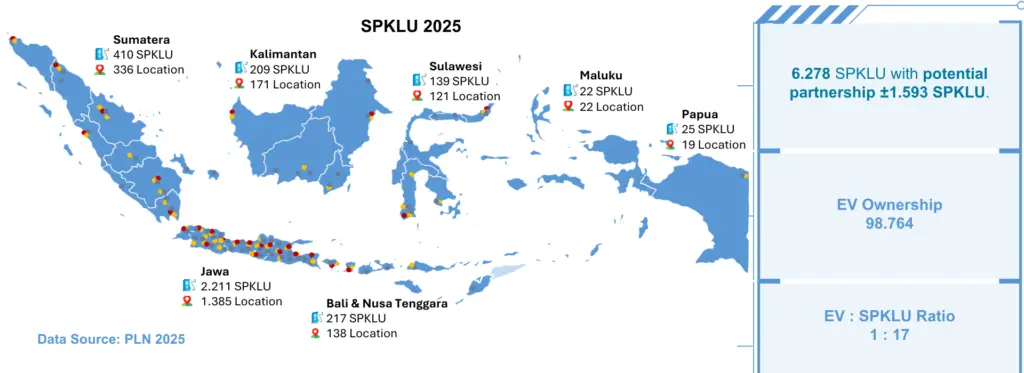
But the current EV-to-charger ratio is at 1:21 — hardly optimal. This gap has led the government, via PLN, to develop a target of 6,278 SPKLU units by 2025, which has a target ratio of 1:17 EVs and charging stations. However, they have highly centralized regional distribution. Java leads with 5,227 planned SPKLU units and the remaining regions such as Sumatra, Kalimantan, Sulawesi, and Papua with less than 1,000 units.
This disparity creates opportunities and challenges alike — a red flag which encourages stakeholders, government agencies, and developers to step up the scale of the SPKLU network across Indonesia.
The Roadmap Guide of Permen ESDM No. 1/2023
The Roadmap Guide (Regulation Overview: Permen ESDM No. 1/2023 Deploying SPKLU infrastructure does not exist solely because of technology but more importantly because regulatory compliance is paramount. Permen ESDM No. 1/2023, which establishes:
- Charger certification standards — all equipment must meet national safety and interoperability benchmarks
- Charging categories — from standard (AC) to ultra-fast (DC), ensuring user accessibility
- Service fees and tariffs — PLN regulates energy costs at Rp 2,466.78/kWh, with service charges for fast chargers capped at Rp 25,000/session or Rp 933.22/kWh (ultra-fast chargers capped at Rp 57,000/session)
Failure to follow these standards will result in delayed approvals, operation penalties, or even legal conflicts — all threats that can damage a project’s success.
Consideration on a Compliant Charging Site
Introduce smart energy management features such as load balancing and scheduling ;
- Technology Selection & System Design: Depending on user demand, use either AC (medium) or DC (fast/ultra-fast) chargers Integrate OCPP-compliant systems for interoperability
- Procurement Flexibility: Developers can choose to obtain certified charger units from trusted suppliers such as Pingalax and incorporate them into their infrastructure.
- Legal Compliance & Permitting: Secure local government and utility permits Aligning system specifications with Permen ESDM No. 1/2023 standards
Collaborate with PLN to ensure grid integration and operational tariffs:
Pingalax’s Readiness; The Platform for SPKLU Certified Deployment Whether you are to deploy a full SPKLU site or just source certified charger units integrated into existing infrastructure, Pingalax offers a full stack capability developed to meet national goals and to support the implementation of SPKLU projects.
We are capable of the following:
- Certified EV Chargers (AC and DC) (consistent with Indonesian standards) for all charger types (medium, fast, ultra-fast)
- Pingalax OS (manages charging, energy storage and solar integration with real-time control and monitoring)
- Controller Stack (modular, OEM-ready and versatile to any deployment scenario)
- Regulatory alignment (system architecture developed to Permen ESDM No. 1/2023 requirements at scale)
- Integration with PLN’s service fee plans along with energy management systems to allow effective cost management.
Complete SPKLU infrastructure can be deployed in Indonesia by the following channels:
- Government (PLN or local government):
- Charging Network Operators (independent or working with PLN):
- SPBU - malls - parking lots - private landowners Based on Indonesia’s Ministry of Energy Regulation No.1/2023, the SPKLU can be developed by several entities such as the following:
- Private sector (developers and investors) Local government Fuel stations (SPBU)
- Malls Private landowners Electricity, If SPKLU is connected with PLN grid, you need coordination with PLN (grid power connection, capacity, electricity tariff). And on another note: Hybrid energy systems with PV (solar panels) and ESS (Energy storage systems), for example, Pingalax solutions to minimize energy costs and dependency on PLN. License holder:
- If you are not registered under the IUJPTL (Electricity Supporting Services Business License), you may get a license holder which manages the SPKLU on a daily basis through the electricity sales channels. As a facilitator or developer — such as a landowner or investor — you can still build and own the SPKLU infrastructure and do not need to be an operator yourself.
Develop full SPKLU networks Seek certified chargers and systems from suppliers such as Pingalax Private Corporate (malls, business, property owners): Bring SPKLU to their sites for value and sources of cash Investments in chargers & software from Pingalax for easy compliance
Set up charging networks Acquire chargers, and OS to manage a network Pingalax models all these — it enables integration of hardware and software systems to be satisfied in regulatory compliance and operational needs.
* Requirements: You are expected to meet a number of standards, which can include connector types, charging, and interoperability. Pingalax fully satisfies these needs, thanks to its EI Charge App.
SPKLU rollout models: do you build with PLN/independent?
Electric vehicles are on the rise but so is appropriate charging infrastructure — and that’s where SPKLU (Stasiun Pengisian Kendaraan Listrik Umum) comes in. If you’re thinking about developing an SPKLU site — whether with a rest area in mind, in a commercial zone, in your EV fleet infrastructure — one of the first decisions you will have to make is: should I build it as part of PLN’s ecosystem, or use it independently?
This article takes you through that decision — from technical and business to regulatory implications — so that you can make the correct one. SPKLU Deployment Paths: In Indonesia, there are two primary deployment routes for SPKLU project:
Option 1: Integration with PLN (Integrated Ecosystem)
This model links the sites directly to the PLN system, meaning: You use PLN electricity tariffs and service rules You integrate with the PLN Mobile App Revenue is regulated or shared under national schemes This is often seen in large-scale public infrastructure sites-toll roads, highway rest areas, or government-planned urban zones.
Option 2: Independent Service
You own the site, buy the chargers, and charge only for the service at (your local fee) You use your own app: things like Pingalax App, EI Charge, you control your revenue, technical backend, and user experience This method is often preferred by mall owners, fleet operators, and land developers who want greater flexibility in their services.
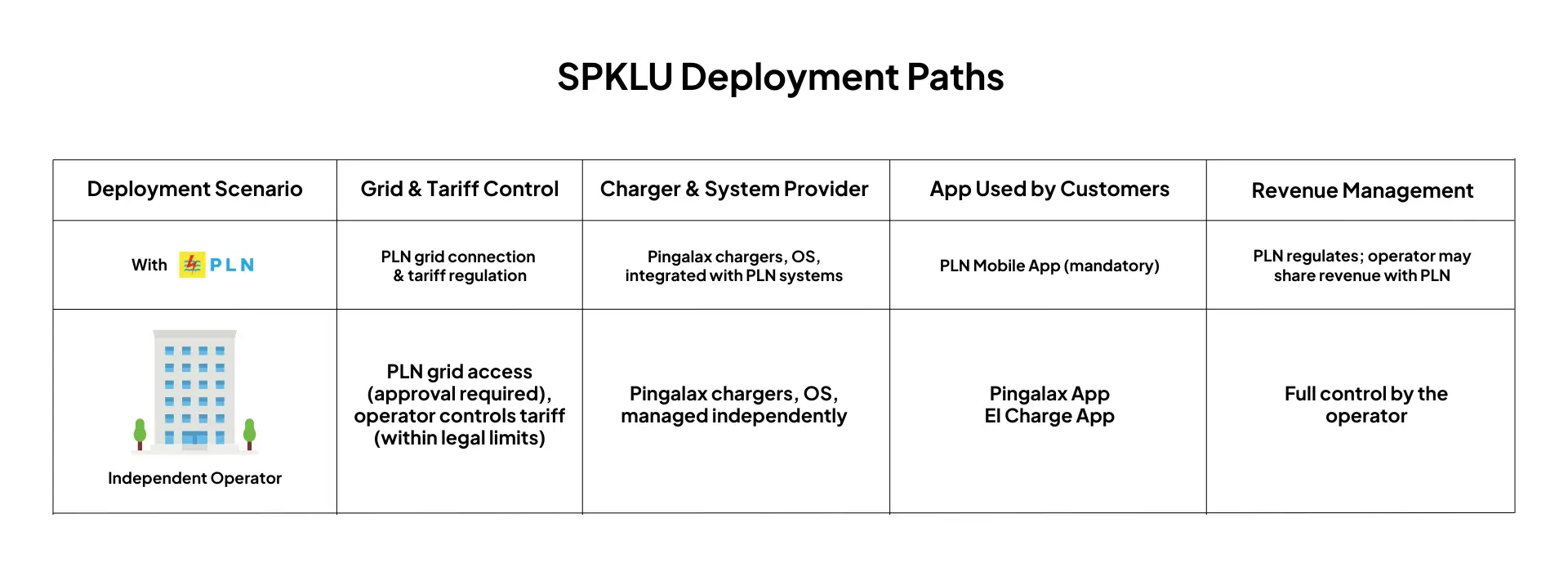
Key Differences at a Glance
| Feature | With PLN | Independent Operator |
|---|---|---|
| Grid connection | PLN-controlled | PLN grid (approved) or hybrid (ESS) |
| Tariff control | Regulated | Flexible (within legal caps) |
| Customer app | PLN Mobile (mandatory) | Pingalax App or custom app |
| Revenue model | Shared or regulated | Full ownership by operator |
| Charger sourcing | Open to certified providers | Open to certified providers |
| Software & OS | Must integrate with PLN backend | Full flexibility (Pingalax OS ready) |
Reminder: Licensing Still Matters No matter what model you’re using, you‘ll definitely need an SPKLU ID (registered with the Ministry via SLO/SPKLU process).
An IUJPTL license (in order to sell electricity directly to an independent operator) If you’re only the site developer, you won’t need IUJPTL — however, your operating partner will need one.
How Pingalax Supports Each Model?
We believe in PLN connectivity or full operating independence; hence, we offer:
- Certified chargers (AC and DC)
- Business model flexibility (ROSO, POSO, RLSO; etc.) We assist our developers to ensure compliance with SPKLU requirements, better energy management, etc., while executing SPKLU sites with a shorter setup time and a lower cost.
Pingalax OS (operational admin); and applications for controlling power consumption/charging operations.
Then Which Is the Right Suited for You? If you're building in a government-coordinated area → PLN model may be preferred If you are operating in a private location (mall, fleet depot, business district) → Independent model offers more ROI control.
Still unsure?
In our next blog post, we’re going walk through the licensing structure, including IUJPTL and SPKLU registration.
This Article is Part of the SPKLU Developer Series
In this series:
- What is SPKLU? → Read it here
- SPKLU Licensing → Coming next
- Revenue models, technical standards, site planning
All articles will be compiled into a downloadable whitepaper. Watch what happens to the full version — or reach out to us to begin planning your deployment of the next SPKLU with Pingalax.
Product Page: Please visit our product pages to find out more about our certified chargers, OS platform and energy management systems.